


Office design lighting
Discover our office lamp catalogue and transform your workspace. Desk, floor, pendant and ceiling lamps to illuminate your office in style.
Más información sobre Office design lighting
In the modern workplace, adequate lighting is a crucial factor in ensuring productivity and wellbeing at work. Office lamps are a fundamental complement within designer lighting and form an essential part of workplace décor. Poorly planned lighting reduces concentration and increases eye strain throughout the working day, while a well-chosen solution improves performance and adds character to the space. In this guide we review the types of office lamps available — desk, floor, ceiling and pendant — how to interpret their technical specifications, and how to combine them with the rest of the furniture to achieve a coherent and functional workspace. Whether you are looking to equip a home office or a corporate office, here you will find the key criteria to consider before making your choice.
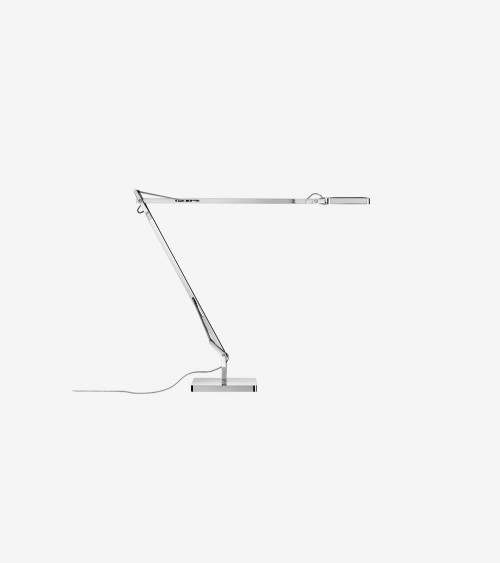
Not all office lamps serve the same purpose, and choosing the right type depends on how you intend to use the space. Office desk lamps provide focused light and are the most common option for individual workstations, as they allow the beam of light to be directed precisely over the work area. They typically feature adjustable arms or swivelling heads, making them ideal for precision tasks such as graphic design, reading technical drawings or detailed administrative work.
Floor lamps for offices provide more general and ambient lighting. They work well in large offices, meeting rooms or waiting areas, where the aim is to complement natural light without creating harsh shadows on the desk. Clip-on lamps, for their part, attach directly to the edge of the desk and are a practical solution for smaller spaces, as they take up no work surface.
The practical recommendation is to combine at least two levels of light: an ambient source (ceiling or floor) and a task source (desk or clip-on) directed at the exact point where visual work is concentrated.
Office ceiling lamps are the most common solution for uniformly lighting meeting rooms, reception areas and communal spaces, as they distribute light without taking up space on desks or worktops. Within this group, pendant lamps for offices have gained prominence in recent years as both a decorative and functional element: they allow specific areas to be defined (a meeting table, a reception point) and bring a design dimension that a traditional flush fitting cannot offer.
When choosing between the different types of office ceiling lamps, it is worth considering the clear height of the room: in spaces with low ceilings, a recessed or semi-recessed fitting avoids a feeling of oppressiveness, while in rooms with high ceilings a pendant lamp can lower the visual line and create a more intimate atmosphere, particularly in reception areas or informal meeting rooms. These solutions are common in modern office lighting where the aim is to combine functionality and design in a single light source.
As with other types, LED ceiling and pendant versions are the recommended option due to their lower energy consumption and longer lifespan, while many models also allow the intensity or colour temperature to be adjusted according to how the room is used throughout the day.
Two technical specifications largely determine whether an office lamp is genuinely useful for working: lumens (the amount of light emitted) and colour temperature, measured in Kelvin (K). For standard office tasks, a range of between 400 and 800 lumens at the point of work is recommended, depending on whether the room already has additional ambient light, such as that provided by ceiling lamps.
As for colour temperature, cool light (between 5,000 and 6,500 K) promotes concentration and is common during morning hours, while warm light (between 2,700 and 3,500 K) is more comfortable for long sessions or afternoon working, as it reduces the sensation of visual fatigue. Lamps with adjustable colour temperature allow this value to be changed according to the time of day or the type of task.
For those who spend many hours in front of a screen, it is advisable to prioritise lamps with diffusers that prevent direct glare and distribute light evenly.
LED technology has become the standard in office lighting due to its lower energy consumption and lifespan, which in many cases exceeds 25,000 hours compared to the 1,000–2,000 hours of a traditional incandescent bulb. This translates into direct savings on the electricity bill and less frequent replacement, for both desk and floor lamps as well as ceiling and pendant LED models.
When comparing LED lamps, it is worth checking the European Union energy efficiency label (classes A to G since the 2021 reclassification) and the CE marking, which certifies that the product meets European electrical safety regulations. These details are usually found in the technical datasheet for each product and are an objective quality indicator, beyond design alone.
Beyond energy savings, LED lamps provide a more stable, flicker-free light, which reduces eye strain during long hours in front of a computer.
Not all professional profiles require the same type of lighting, and choosing according to actual use avoids purchasing a lamp that does not suit the demands of the role. Those who work with physical documents, technical drawing or precision crafts benefit from desk lamps with a multi-joint adjustable arm, which allow the light source to be brought close to a specific detail without repositioning the rest of the fitting.
Those who spend most of the day in front of a screen generally need less direct intensity and more uniformity, so it is advisable to prioritise models with a wide diffuser and dimmable intensity control, in order to reduce the contrast between the screen and the surrounding environment. For profiles that combine video calls with desk work, a lamp with adjustable light and colour temperature also helps improve facial lighting during meetings.
The choice of lamp should not be made in isolation from the rest of the space. To create a coherent workspace, it is worth considering its integration with work desks and office chairs, both functionally and aesthetically. This also applies to reception areas, where a well-chosen pendant or ceiling lamp sets the tone of the space from the moment you walk in.
On a functional level, the height and reach of the lamp arm should be adjusted to the height of the desk and the usual working position, to avoid shadows being cast on the surface. On an aesthetic level, maintaining a consistent design language between the lamp, the designer desks and the designer chairs reinforces the sense of a polished and professional space, something especially relevant in offices that receive visitors or hold video calls with clients.
At Exento Shop you will find an extensive catalogue of office lamps, alongside the rest of our designer furniture, with everything you need to complete your workspace, fast and secure delivery, and a support team offering personalised assistance.
How many lumens does an office lamp need?
For a standard desk, between 400 and 800 lumens at the point of work are recommended, adjusted according to the ambient light already available in the room.
What colour temperature is best for working?
Between 4,000 and 5,000 K for a balance between concentration and visual comfort; cooler light (5,000–6,500 K) for tasks requiring sustained attention, and warmer light (2,700–3,500 K) for long sessions or afternoon work.
When should I choose a ceiling or pendant lamp instead of a desk lamp?
Ceiling and pendant lamps are ideal for lighting meeting rooms, reception areas and communal spaces without taking up work surface. Desk lamps, on the other hand, provide focused light for precision tasks at the workstation.
Is it worth paying more for a dimmable LED lamp?
If you work more than four hours a day in front of the lamp, yes: the ability to adjust intensity and colour temperature allows the light to be adapted to different moments of the day and reduces accumulated eye strain.
What is the difference between a task lamp and an ambient lamp?
A task lamp (desk or clip-on) illuminates a specific work point with high precision; an ambient lamp (floor, ceiling or pendant) illuminates the room in general. The ideal solution is to combine both in order to avoid excessive contrast.